Wednesday, August 30, 2006

Nationalist Tide

Koichi Kato repeated again that a right-wing nationalist tide threatens Japan. He told the Foreign Correspondents Club yesterday that the right-wingers are like drifting balloons. Interesting comparison.
Kato said Japan had lost its moorings and that individuals, disconnected from traditional family, work and community anchors, were floating like helium balloons on air currents.

"Even in the slightest breeze they will all start floating in the same direction," the one-time prime ministerial candidate said.

"And if there is a nationalistic mood that takes over the country, all of these balloons will begin to drift in a very strong way along this current."

Right-wing nationalist tide threatens Japan, warns political veteran (The Age 2006/08/29)

Thursday, August 24, 2006

Wereldnet 23 augustus

Gisteren was het alweer Wereldnet. Ditmaal met de drie Belgische correspondenten van het Nederlandse Wereldnet: Bart Van Bockstaele in Toronto, Canada , Armando Janssen in Venezuela en mezelf in Japan. Dit was een van de laatste middaguitzendingen van Wereldnet op Radio 747. Vanaf 4 september verhuist het programma naar de nachtprogrammering op Radio 1.

Voor Japan heb ik gesproken over: 1. Obon-verlofperiode; 2. Het Japanse kroonprinsenkoppel in Apeldoorn; 3. Overstromingen en tyfoons; 4. Het populaire baseballtornooi tussen middelbare scholen

Audiobestand via de Wereldnetsite (of download hier – 9376kb)

Elderly Foreigners

I do not intend to go back to my country. Probably I will die in Japan. Hopefully at an old age after a rich life. What is my wife dies first and I'm left behind as an old man? There will to many old people in Japan. The health care system will be under pressure. Will foreigners get similar levels of medical and nursing-care services as the Japanese? I'm not sure:
"Terri Nii, who has lived in Japan for more than 20 years and speaks fluent Japanese, is far from being dependent on her Japanese husband. But the 49-year-old resident in Fujisawa, Kanagawa Prefecture, is concerned what her life in Japan will look like in another 20 years.

She fears that the Japanese government may single out foreigners as the first target when it reduces medical outlays, nursing-care benefits and pension payouts.

Japan is expected to become unable to maintain the same level of social security benefits because of its aging population and declining birthrate, unless it slashes expenditures and raises taxes.

Nii, a California native, is arguably one of the most visible foreign residents in Kanagawa Prefecture. She runs a company in Fujisawa and sits on advisory panels to the municipal and prefectural governments.

But she said foreign nationals are in a sense invisible in Japan, where they are not granted what she calls regular status.

One reason is that foreigners are not covered by the resident registration systems, managed by local governments.

"I am a producing, tax-paying citizen in Japan, but I am not considered an official resident," said Nii. "I am uneasy about my status in the future when I may need to receive benefits rather than pay into the system.
"

Growing Old in Japan: Future care (Asahi – 2006/08/12)

Thursday, August 10, 2006

Lovely Voices

A Japanese man was arrested this week after making 37,760 silent calls to directory enquiries because he wanted to listen to the 'kind' voices of female telephone operators.

"When I made a complaint call once, the operator dealt with it very kindly, so I wanted to hear these women's voices," the daily Mainichi Shimbun quoted him as telling police in Hiroshima, western Japan.

Japan man makes 37,760 calls to 'kind' operators (Reuters – 2006/10/06)

Local Tokyo Shopping Street: Past and Present

Roger Pulvers in The Japan Times:
"In 1983, I conducted a survey of all of the goods and services offered on the kilometer-long shotengai (shopping street) running from the station up to the turnoff to our little flat (...)": See article (JT - 2006/7/30)

"Now I have gone back to resurvey the shotengai, to find out how a Tokyo neighborhood has changed over the course of a generation": See article (JT - 2006/8/06)

Wednesday, August 09, 2006

The Japanese should worry about Yasukuni 'in defense of their own freedoms'

Foreign Minister Taro Aso proposed on Tuesday making the Yasukuni Shrine for Japanese war dead a secular, state-run memorial. This could clear the way to remove the 14 Class-A war criminals from the lists of those honored there.
(See: Japan’s Aso wants state to run Yasukuni war shrineReuters 2006/8/08).

In my humble opinion Aso’s proposal is totally useless. First of all, I’m not sure that a state-run Yasukuni state-run would be a good idea as it will remember some of the wartime policies when Yasukuni was used by the government as a political tool to indoctrinate the population.

But more importantly, even if the 14 Class-A war criminals are removed the controversy around Yasukuni will not end for reasons Ian Buruma explained very well in an opinion article several months ago:
"To focus only on the Class-A war criminals is to ignore the essence of the shrine. Koizumi's claim that Japan is now a peaceful nation with no military designs on its neighbors may be true, but it is beside the point. And he is either ignorant or dishonest when he claims that visiting the shrine is simply 'a matter of the heart.'

For Yasukuni Shrine is in fact a deeply political institution, established in 1869 to remember the men who died for the emperor. Japan did have an ideology that glorified militarism, racial superiority, and emperor worship. Going to war to bring Asia under the roof of the divine emperor was promoted as a sacred mission. Dying for the emperor was propagated as the highest virtue. That is why soldiers believed that they would meet after death at Yasukuni Shrine.

The glorification of militarism was not unusual at that time. Most European countries did the same, at least until the end of World War I. The association of monarchs with military glory was not unusual either. What made Japan unique was that this association became both a state religion and a political ideology, of which Yasukuni Shrine is the prime symbol.

The Japanese should care more about this, not because of Chinese or Korean protests, but because it did such harm to Japan itself.

For the blend of religion and ideology represented by State Shinto and emperor worship not only justified military aggression in Asia but also destroyed every attempt by the Japanese to establish a liberal democracy at home.

It deprived the Japanese population of the right to free speech. It demanded blind obedience of the Japanese armed forces to the emperor, and not to elected civilian governments. It led Japan into a brutal war, and it wrecked any chance for Japanese civilians to stop it.

Walking around Yasukuni Shrine today, you get the impression that none of this ever happened. Instead, a visitor to the museum is subjected to the same old excuses used by the military leaders of wartime Japan: Japan was forced into a war by foreign powers; Japanese soldiers fought bravely for freedom in Asia and peace in the world; their sacrifice should be a shining example to future generations, who owe their prosperity to these selfless martyrs of the imperial cause.

This is what makes the shrine such a disturbing place. Not the Class-A war criminals, but this destructive ideology, which has survived intact, despite war crime trials, democratic government, and more than half a century to analyze, debate, and reflect on the catastrophes of the past.

Japan is a free country, of course, and if people want to continue believing in emperor worship and wartime propaganda, they should be allowed to do so.

But if the prime minister himself insists on paying his respects at a place that represents these views, then it is not only other Asians that should worry about whether the Japanese have learned the lessons of the past. The Japanese should worry about it too, not to appease foreign critics, but in defense of their own freedoms."

Ian Buruma: The Yasukuni Problem (Kyodo News- 2006/1/30)
I think that the only solution will be to create of a new secular state war memorial totally separated form Yasukuni symbolism.

Saturday, July 29, 2006

Japan scoring low on the list of happiness

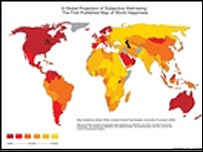
World map of happiness. Japan only 90th:
"If it is happiness you are seeking a move to Denmark could be in order, according to the first scientist to make a world map of happiness. Adrian White from the University of Leicester in the UK used the responses of 80,000 people worldwide to map out subjective wellbeing.

A nation's level of happiness was most closely associated with health levels. Wealth and education were the next strongest determinants of national happiness.

Denmark came top, followed closely by Switzerland and Austria. The UK ranked 41st. Zimbabwe and Burundi came bottom. Mr. White said he was surprised to see countries in Asia scoring so low, with China 82nd, Japan 90th and India 125th" (...)
Denmark 'happiest place on earth' (BBC News – 2006/7/28)


World map of Happiness
Happiness Map (pdf - 146 kb)

Friday, July 21, 2006

Working but poor

Sorry, again about the widening income gap. As I said last week in Wereldnet: it will become that bad that some will work but still be poor:
"In Japan the poverty rate is higher for single-parent families that work than for those that do not work," said OCDE’s senior economist Randall Jones. "In Germany the solution is, get those single families to work and then they escape poverty. In Japan they're already working. The problem is the income is too low. So there's not the easy solution to say 'let's just find them jobs'."

OECD Concerned About Rising Poverty in Japan (VOA – 2006/7/20)

Thursday, July 20, 2006

Widening income gap

A few months ago Koizumi downplayed social polarization. He said in the Diet: "Statistics haven’t confirmed that the income gap has widened"

Hopefully PM Koizumi will take a good look at the statistics the OCDE published today:
Japan ranked second worst among advanced economies in 2000 in terms of the relative poverty rate partly because non-regular workers with low wages increased amid the prolonged economic slump, the Organization for Economic Cooperation and Development said Thursday.

The proportion of the population living in relative poverty, defined as less than one-half of the median household disposable income, came to 13.5 percent in 2000, the second highest among OECD members following 13.7 percent in the United States, the OECD said in a survey on the Japanese economy.


Japan ranks 2nd worst among OECD nations in relative poverty (Kyodo – 2006/7/20)

Sunday, July 16, 2006

Don't get dumped by your wife

Those are married to a Japanese woman will know that Japanese wives can be pretty scary. Here is some useful advice from a group of men who don’t want to get dumped by their spouse:
The group's main activity is regular get-togethers at local izakaya Japanese-style pubs. They discuss what their wives are like and how to deal with them depending on the situation.

"For example, we've come up with a rule never to sit opposite your wife when she says, 'Could you please sit down. I have something to say to you,'" Amano says.

"In most cases, their eyes are too terrifying to face, and it's most likely things will start flying across the room at you."

Amano says the best thing to do on these occasions is to sit beside your wife, hold her hand until her anger passes, and then apologize profusely before she even brings up what you did wrong.
Husbands reform to keep from getting dumped (Asahi – 2006/7/15)

Tuesday, July 11, 2006

Interview Wereldnet - Portret

Tijdens de zomermaanden voert het Nederlandse radioprogramma Wereldnet lange gesprekken met zijn correspondenten over heel de wereld. Dinsdag 11 juli was het mijn beurt. 'Het verhaal van een Belg in Japan':
Audiobestand via de Wereldnetsite (of download hier - 16220kb)

Interview: N-Koreaanse dreiging

Uit peilingen blijkt dat vier op de vijf Japanners zich bedreigd voelen door de Noord-Koreaanse raketlanceringen.

Gisterenavond kreeg ik een telefoontje van het nieuwsprogramma 'De Wandelgangen' van Radio 1 met de vraag hoe erg Japan zich zorgen maakt:
Audiobestand (mp3- 1020 kb - 4min 30sec)

Saturday, July 08, 2006

'Just watch and find out'

De dreigementen van het Noord-Koreaanse regime nemen een belachelijke wending. "Just watch and you will find out", zou ik eerder verwachten uit de mond van een puber:
A North Korean ambassador Friday blamed Japan for Pyongyang's missile launchesA North Korean ambassador Friday blamed Japan for Pyongyang's missile launches and warned that any complaints from Tokyo would be met with "an even stronger physical response".

When reporters asked the ambassador if a "strong response" meant new missile launches or nuclear weapons development, he said, "Just watch and you will find out."
N. Korea warns of 'stronger' action (Asahi – 2006/7/08)

Rakettencrisis

Het was niet zo aangenaam om deze morgen op te de staan en onmiddellijk de crisissfeer aan te voelen tijdens het ochtendnieuws: 'Noord-Korea heeft drie raketten afgevuurd', hoorden we tijdens het nieuwsbulletin van 6h30. Daarna was er sprake van vier, vijf en uiteindelijk zes raketten. Alle raketten zijn tussen 3.30u en 8.30u afgevuurd en in de Japanse Zee beland.

Het nieuws was zo overweldigend dat de NHK, de openbare omroep, besliste dat het ochtendfeuilleton moest wijken voor de actualiteit. Hoogst ongebruikelijk in tv-amusementland Japan. Dit was niet meer gebeurd sinds de grote Hanshin-aardbeving van 1995.

Ervaring met dreigende Noord-Koreaanse raketten hebben we al. In 1998 heeft Noord-Korea een Taepodong 1 afgevuurd die over het Japanse grondgebied is gevlogen. Noord-Korea beweerde toen dat het om de 'lancering van een satelliet' ging.

Veilig voelen we ons allesbehalve om naast zo een grillig en onvoorspelbaar regime als Noord-Korea te moeten leven.

Noord-Korea ligt al een hele tijd in de clinch met Japan over diverse zaken, onder meer de trieste ontvoeringszaak die geen oplossing vindt. Maar de provocatie van vandaag moeten we plaatsen in het kader van het zeslandenoverleg over het Noord-Koreaanse kernprogramma. Dat overleg ligt al maanden in het slop. Het is aannemelijk dat de Noord-Koreaanse leider, Kim Jong-il, de Verenigde Staten onder druk wil zetten om het overleg weer op gang te trekken.

Japan heeft 'strenge tegenmaatregelen' beloofd. Zeker is dat de samenwerking tussen Japan en de VS nog verder zal toenemen: levering van Patriot-raketten, samenwerking voor de ontwikkeling van een rakettenschild…

Japan en de VS zullen alles doen om een brede internationale veroordeling te bekomen. Als er één ding is dat Noord-Korea vandaag bereikt heeft, dan is het om zichzelf nog verder te isoleren op het wereldtoneel.

In Japan zijn we er niet helemaal gerust in. We kunnen niet uitsluiten dat het Noord-Koreaanse regime de ene of de andere dag helemaal doorslaagt.

--
Oorsponkelijk gepost in de De Standaard Expatblog (2006/07/05)

Wednesday, July 05, 2006

Interview

De nieuwsredactie van de VRT-Radio heeft me enkele uren na het uitbreken van de Noord-Koreaanse rakettencrisis geïnterviewd over de kwestie voor ochtendnieuwsbulletins en het actualiteitenprogramma 'Voor de Dag'.

Het interview met de correspondent in Washington en mezelf in Japan: Audiobestand (mp3 – 1.677kb)

N-Korea fires 6 missiles

N-Korea has fired 6 missiles this morning between 3.30am and 8am. What does N-Korea think to gain? No doubt that Japan will impose economic sanctions. The whole civilized world condemns N-Korea.

Cooperation between Japan and the US will certainly intensify. Within hours (around 7am) the American ambassador in Japan had already talks with the foreign minister, Taro Aso, and Chief Cabinet Secretary, Shinzo Abe. Significant is that this meeting with the American ambassador took place even before Premier Koizumi started a security meeting with is top ministers.

N Korea tests long-range missile (BBC News - 2006/7/05)

Tuesday, July 04, 2006

Murakami worried about nationalism

Haruki MurakamiNovelist Haruki Murakami has attacked Japanese nationalism in an interview with an English-language newspaper based in Hong-Kong. He also revealed plans to deal with the issue in his next novel.
"I'm worried about my country," the author told the South China Morning Post. "I feel I have a responsibility as a novelist to do something."

He singled out Shintaro Ishihara, the right-wing governor of Tokyo, for particular criticism, calling him "a very dangerous man" (...) "He's an agitator," Murakami reportedly said. "He hates China.
"
Murakami hits out at Japanese nationalism (The Guardian - 2006/7/04)

Saturday, July 01, 2006

Off-Topic: How to get music OFF your iPod

My computer broke down this week. Too lazy to back up regularly my files, I lost of lot of data. All my music files vanished, except the 3,5 GB music files in my iPod. I tried to transfer the music files to the hard disk drive of my new computer, but amazingly is it impossible to transfer files from an iPod to anywhwere else! I thought Apple was user friendly, but this is awful bad.

Via googling I found finally a neat little program to circumvent the iTunes limitations:
How to get music OFF your iPod (via Engadget)

Ridiculous

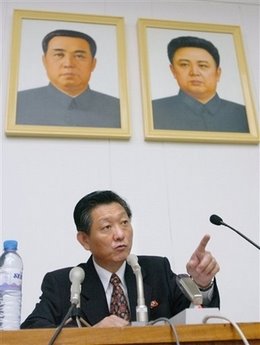
Kim Young Nam, kidnapped by the North in 1978 has denied he was abducted during a press conference in North Korea. The man said that he was "rescued", not abducted, by Pyongyang in 1978.

Of course, the man cannot take the risk to say the truth. Having to depict the horrible N-Korean regime as a rescuer is painfully ridiculous:
"Pyongyang has never admitted to kidnapping South Korean citizens. And Kim Young Nam could hardly say otherwise. His words were spoken inside North Korea under the watchful eyes of authorities. It would be unreasonable to expect Kim to be able to speak freely under such conditions(...)

Reading from what appeared to be a prepared script, Kim soundly condemned Japan's handling of the matter, echoing the official line spouted by Pyongyang(...)

Seoul has certified Kim Young Nam as an abduction victim. Former North Korean spies have testified that he was indeed abducted. Meeting the press, however, Kim denied he was abducted. He has since remarried, and has a son with his new wife. Under these circumstances, he obviously cannot afford to say much about how he arrived in North Korea.
"

Megumi’s Husband (Asahi – 2006/7/01)

Wednesday, June 28, 2006

Computer problems

Computer hardware problems. Off-line for some days. Naar Akihabara in de volgende dagen om een nieuwe computer te kopen. Mijn laptop heeft de geest gegeven.